How to Size a DC-to-DC Charger for a Truck Camper or Van
Match the charger to your house-battery charge rate, the alternator's spare capacity and how many hours you actually drive. A worksheet and a conservative starting point for 12-volt systems.
🖨 Print this how-to One-page checklist, no ads.
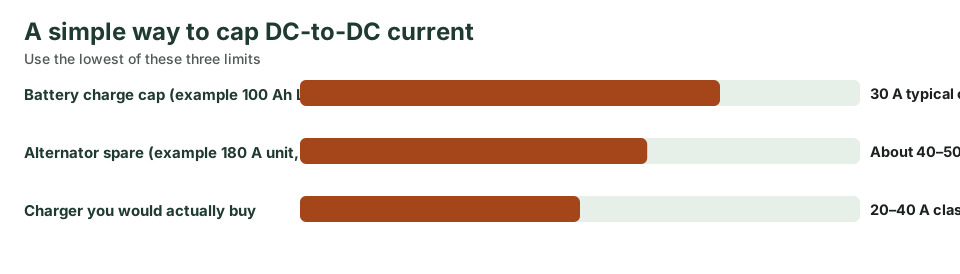
Quick answer: Find the lesser of (1) a safe charge current for the house battery and (2) what the alternator can spare after the truck's own loads. For many short-trip campers, a 20 to 40 A, 12 V charger is the usual range.
Oversizing the charger does not help if the alternator or the battery cannot accept the current.
Start with the battery
A lead-acid house battery is often happiest around 0.1 to 0.2 C (10 to 20 A for 100 Ah). Many LiFePO4 makers allow higher, often around 0.3 to 0.5 C, but the battery manual wins. If the label is silent, stay conservative.
Then look at the alternator
The alternator's rating is not spare capacity. The engine computer, cooling fan, lights and lockers already use a share. In heat, at idle, output falls. A common approach is to leave a large cushion rather than trying to use every leftover amp. If you add a second, dedicated alternator, follow that maker's kit instructions.
Then look at how you drive
A 40 A charger adds about 40 Ah in one hour of highway time, before losses. If you usually drive two hours between camps, even 20 A may replace a modest night of lights and a phone. If you do short hops and run a fridge all day, you need more current, more solar or a larger house battery, not just a bigger charger on a small alternator.
Wire and fusing follow the current
Once you pick the amperage, use the manufacturer's wire-gauge and fuse table. Undersized cable wastes power as heat and is a fire risk.
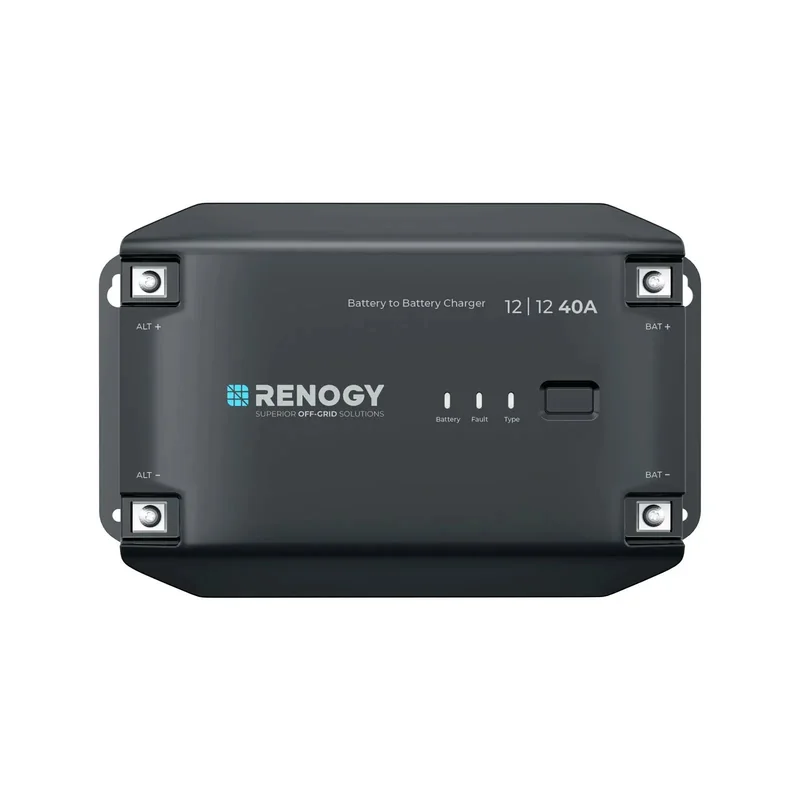
Renogy 12V 40A DC-DC Battery Charger
Charges a lithium, AGM or gel house battery from the vehicle's alternator while you drive, with alternator detection built in.
- Output
- 40 A, 12 V
- Battery types
- LiFePO4, AGM, gel, flooded
- Input
- Alternator (starter battery)
- App
- Optional, with Renogy BT-2 module (sold separately)
Printable checklist: sizing
- House battery chemistry and allowed charge current from the manual
- Alternator rating and a conservative spare-current estimate
- Typical hours driven between camps
- Charger amperage chosen at or below the tightest limit
- Cable and fuse sizes copied from the charger manual
Frequently asked questions
Is a 40 A charger right for a 100 Ah lithium battery?
Often yes, if the battery allows at least 40 A and the alternator can spare it. Check both manuals.
Can I run two chargers?
Only if the wiring, fusing and alternator can support the combined current. Get an electrician involved if you are unsure.
What about charging at idle?
Expect less current, more heat and more wear. Plan to charge on the road, not in the campsite driveway.