DC-to-DC Charging for Truck Campers: Why the Alternator Needs Its Own Charger
A DC-to-DC charger sits between the truck's alternator and the camper battery so you can charge on the drive without hurting the starter battery. Here's how the system works and what to install.
🖨 Print this how-to One-page checklist, no ads.
Quick answer: Run a dedicated DC-to-DC charger from the starter battery (or a second-alternator output) to the house battery. It limits current, applies a proper charge profile for AGM or LiFePO4 and protects the truck battery when you stop.
Tapping the alternator with a simple isolator can work in a pinch, but a DC-to-DC unit is the clean way to charge a camper on a short trip.
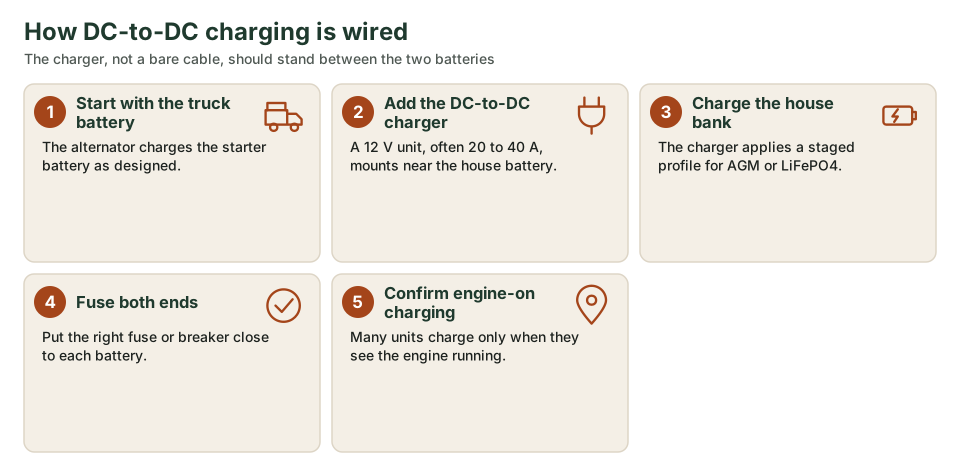
Why a direct cable is a poor plan
A heavy cable and a basic isolator can let a large house battery pull more current than a stock alternator wants to give, especially at idle or in heat. It can also leave the starter battery low if a load stays on after you shut off the engine. A DC-to-DC charger sets a current limit and a charge algorithm.
What the charger does
Units such as Renogy's 40 A DC-DC charger and Victron's isolated Orion-Tr Smart chargers take 12 V in and put out a controlled charge. Many include a lithium profile, ignition or engine-run sensing and, on some models, a solar input. Read the maker's manual for wire size, fuse size and temperature limits.
Isolated or non-isolated
An isolated charger separates the input and output grounds, which helps on a plastic or rubber-mounted camper body and reduces stray-current surprises. Non-isolated units can be simpler on a shared-chassis truck if the manual allows it. Follow the install diagram for your exact model.
Leave the idling trick alone
Do not sit and idle for hours just to fill the house battery. Charge on the drive, then use solar or shore power in camp. Size the unit so a few hours of highway time replaces what you used last night; see how to size a DC-to-DC charger.
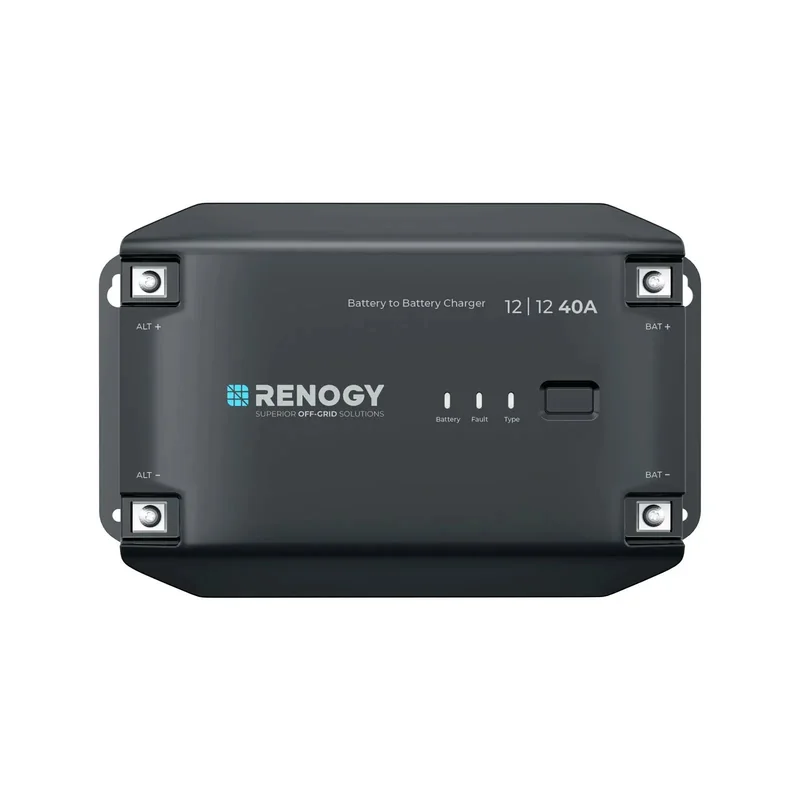
Renogy 12V 40A DC-DC Battery Charger
Charges a lithium, AGM or gel house battery from the vehicle's alternator while you drive, with alternator detection built in.
- Output
- 40 A, 12 V
- Battery types
- LiFePO4, AGM, gel, flooded
- Input
- Alternator (starter battery)
- App
- Optional, with Renogy BT-2 module (sold separately)
Printable checklist: DC-to-DC install
- Charger model chosen for battery chemistry and current
- Wire gauge and fuse sizes taken from the maker's chart
- Fuses placed close to each battery
- Engine-run or ignition sense confirmed
- Charge current measured on a test drive
Frequently asked questions
Can I charge a LiFePO4 house battery from the truck?
Yes, if the DC-to-DC charger has a lithium profile and the wiring is sized for the current. Do not rely on a simple isolator unless the maker says it is safe for lithium.
Does this replace solar?
No. It charges while you drive. Solar covers days you stay put.
Will it kill my alternator?
A properly sized, current-limited charger is much easier on an alternator than an unregulated cable to a large empty battery.