How to Plan Power for a Rooftop Tent Trip (1 to 5 Nights)
A rooftop-tent weekend usually needs far less power than a camper, but lights, a fridge and phone charging still add up. Size a power station or a small house battery for the nights you will actually stay.
🖨 Print this how-to One-page checklist, no ads.
Quick answer: List every 12 V or USB load, multiply watts (or amps) by hours per night, add a reserve and choose a power station or battery that can cover the trip without a long idle. Charge on the drive or with a folding panel.
Most rooftop-tent trips are lights, phones and maybe a fridge, not an air conditioner.
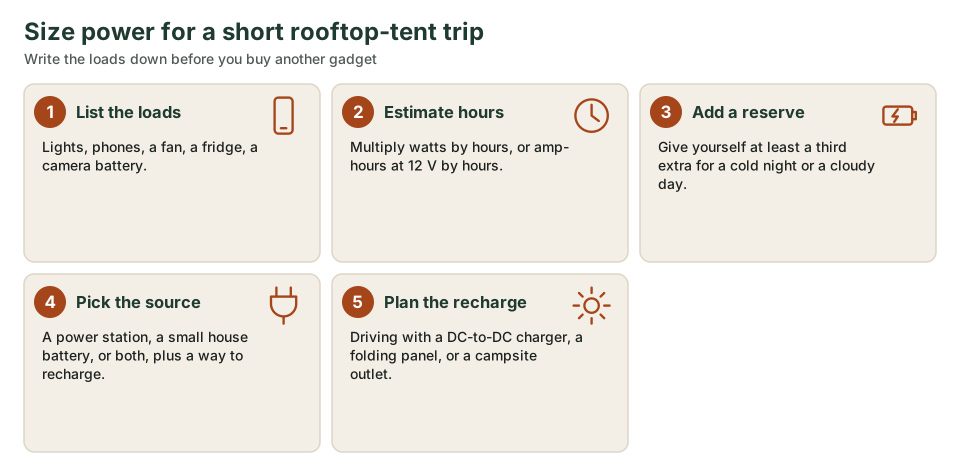
A simple watt-hour budget
A 10 W light for 5 hours is 50 Wh. Two phones might add 20 to 40 Wh. A 12 V compressor fridge can be several hundred watt-hours per day in hot weather; that one item often dwarfs everything else. Add the numbers, then add a reserve so you are not at zero at breakfast.
Power stations versus a wired house battery
A portable power station is enough for many 1 to 3 night trips and is easy to recharge from a wall outlet or a small panel. A wired house battery with a DC-to-DC charger is nicer if you already have a 12 V fridge and you drive every day. See DC-to-DC charging for truck campers.
What not to run
A rooftop tent and a small battery will not run a cabin air conditioner. Keep cooking on a camp stove, not an electric hot plate, unless you have a large station and a plan to recharge.
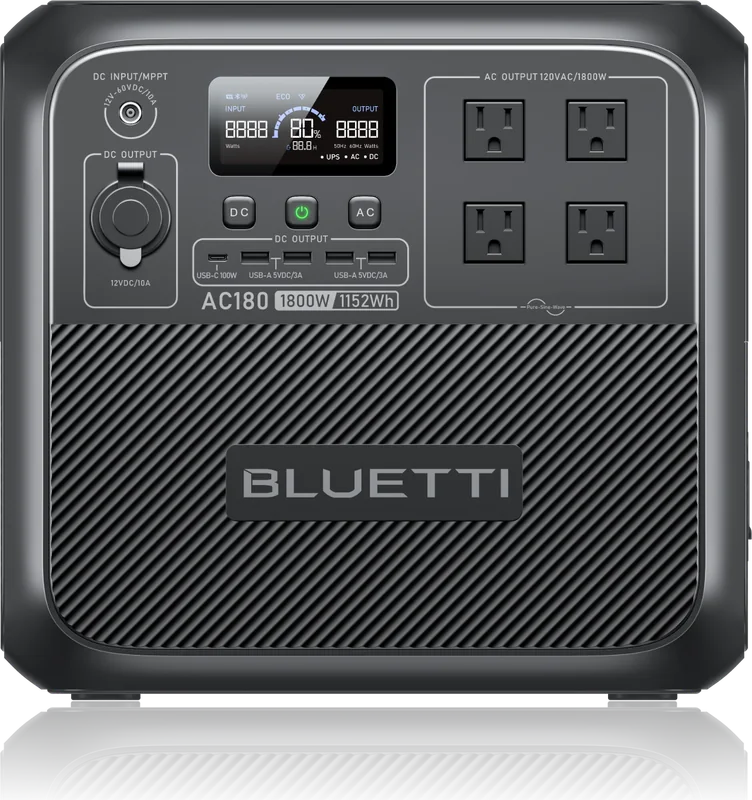
BLUETTI AC180
The most capacity here: 1,152 Wh of LiFePO4 with 1,800 W of AC output.
Pros
- Largest capacity of the three (1,152 Wh)
- Power Lifting mode runs some resistive loads up to 2,700 W
Cons
- Heaviest of the three at 35.3 lb
- Lowest rated cycle life here (3,500+ cycles)
- 500 W solar input
- Capacity
- 1,152 Wh
- Chemistry
- LiFePO4
- AC output
- 1,800 W (2,700 W Power Lifting)
- Max solar input
- 500 W (12-60 VDC, 10 A)
- Cycle life
- 3,500+ cycles
- Weight
- 35.3 lb
Printable checklist: RTT power
- Load list with hours per night
- Battery or station sized with a reserve
- Recharge plan (driving, solar or shore)
- Fridge tested for a day at home if you are bringing one
- Headlamp or lantern as a no-power backup
Frequently asked questions
Can I run a 12 V fridge from a jump pack?
Usually no. Jump packs are for starting engines, not all-night loads. Use a power station or a house battery with a known capacity.
How many nights will 1,000 Wh last?
It depends on the fridge and the weather. With careful lights-and-phones use and no fridge, several nights. With a fridge in the heat, maybe one or two. Measure, do not guess.
Do I need solar on a two-night trip?
Not if you can recharge driving or at a wall outlet. Solar helps when you stay put.